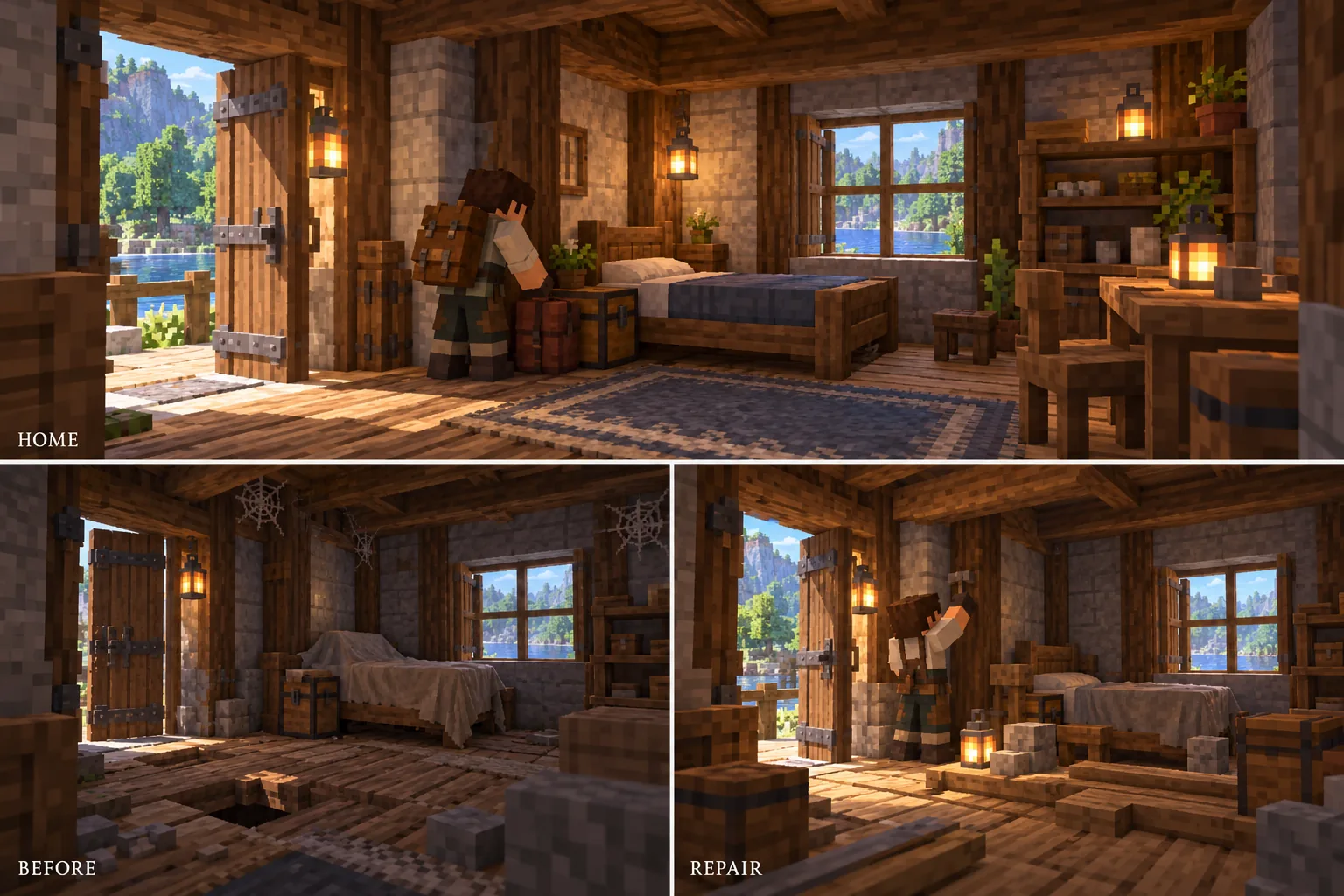
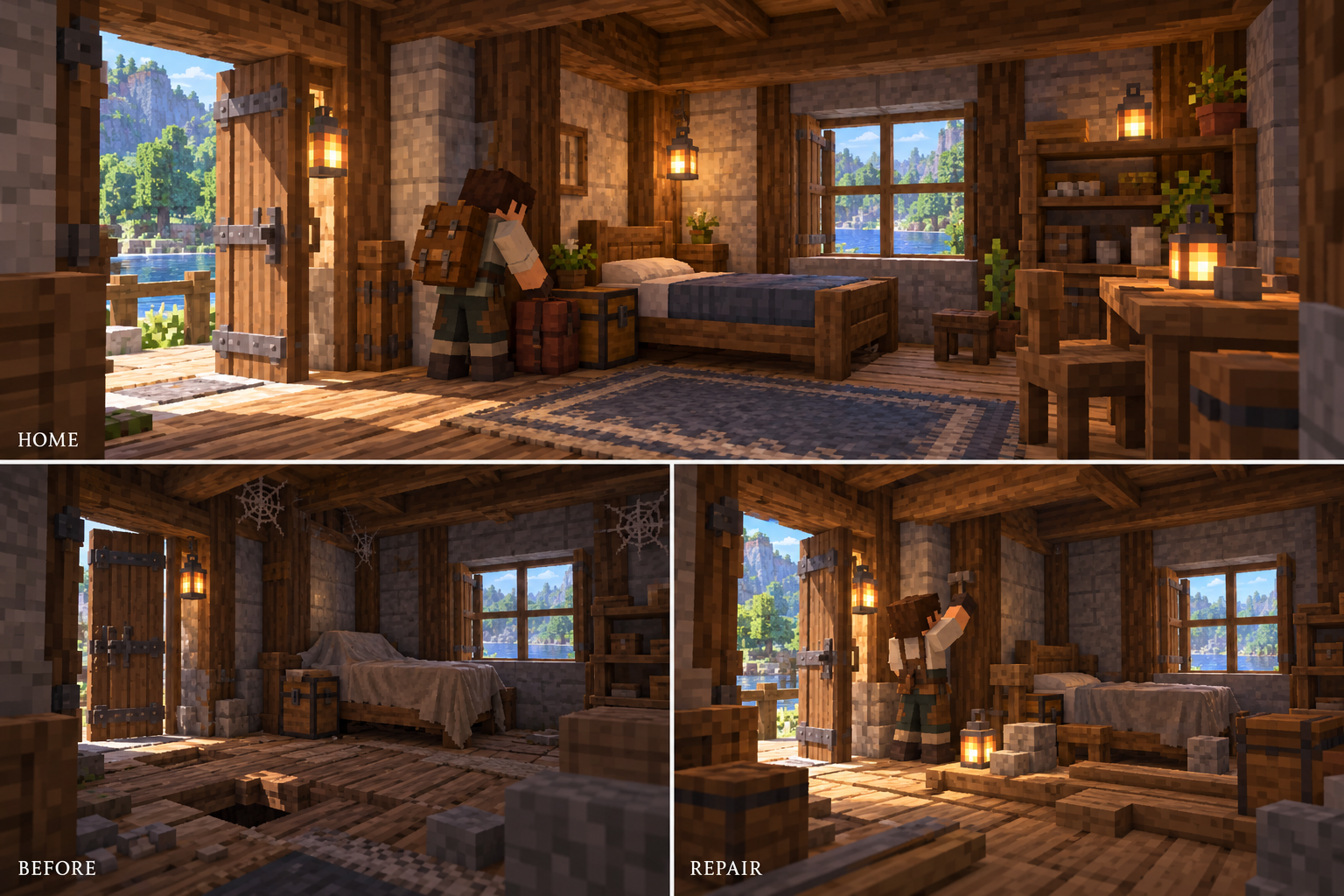
Repair the guesthouse’s enclosure and approach, then restore the room, storage and shared access. The existing bed stays with the room; ordinary tools and crafting are enough to begin.
What changesA recognizable home, personal storage and a clear route through the shared building.
Inspect the far approach, repair the supports and anchors, then finish the deck, approaches and rails. The restored crossing gives a familiar journey a practical new reach.
What changesA usable route to the quarry, with the inspection recorded as knowledge rather than spent as an item.
Restore a carpenter and repair bench, clear work access and repair the fixed-landing cargo hoist. Bring a returned find through the first small production chain to improve its service.
What changesOrdinary stone service, safer cargo handling and one bounded workshop improvement.
Connect the broader service network as the settlement develops. The first quarry workshop introduces this idea, but does not complete the whole chapter.
What changesUseful services that support repeat visits and shared life.
Prepare the settlement for its first market after its working services have developed. This sits beyond the opening guesthouse, crossing and quarry slice.
What changesA place whose working routes and common spaces support an occasion worth returning for.
The guesthouse retains its bed and furnishings. There is no additional bed or wool requirement hidden behind making the room usable.
02
Make access legible
A restored approach, doorway and common route make the room work. Personal storage stays distinct from shared supplies.
03
Finish useful stages
Essential repairs have a clear result. Optional decoration can follow without becoming a condition of shelter.
02 / Work that changes the world
Make the workshop useful.
Begin with a short chain whose result you can see: a restored bench, a batch of fittings and a better cargo route. Later power expands what the same place can do.
01 / Make and repair
Carpenter & repair bench
A repaired quarry work bay handles short, manual structural orders. Its stock and completed work stay visible.
A supported source, storage, distribution and field charging make lights and instruments useful away from the workshop. A fueled source remains an option where geography would otherwise block progress.
Use known motion or a fueled option so geography does not block the first power.
Storage
Keep real charge in a compatible bank; storage and delivery limits are distinct.
Distribution
Give the workshop a readable switchboard and a deliberate service order.
Field charging
Charge existing field batteries for lamps and instruments, counting the source work.
A machine with a readable job
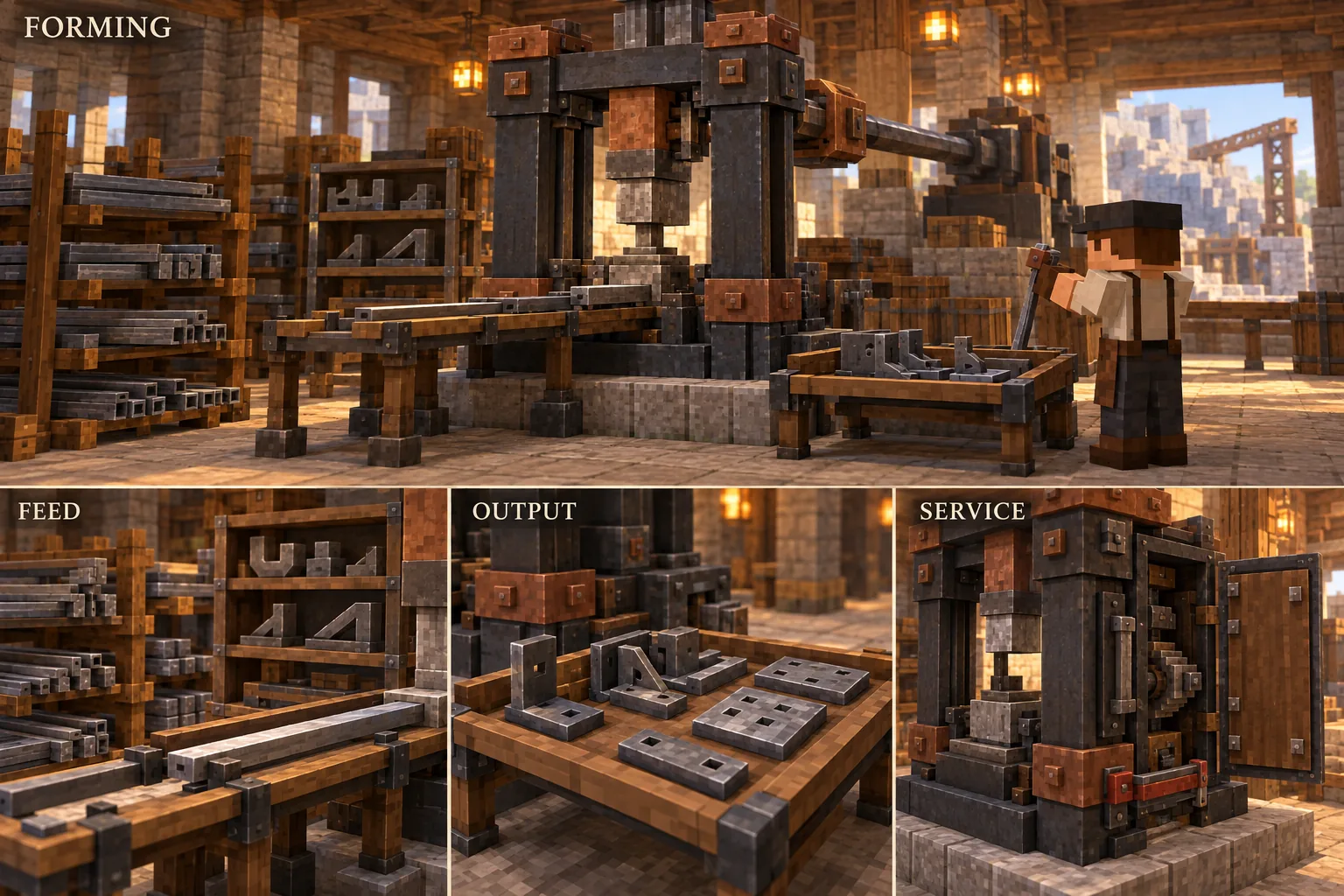
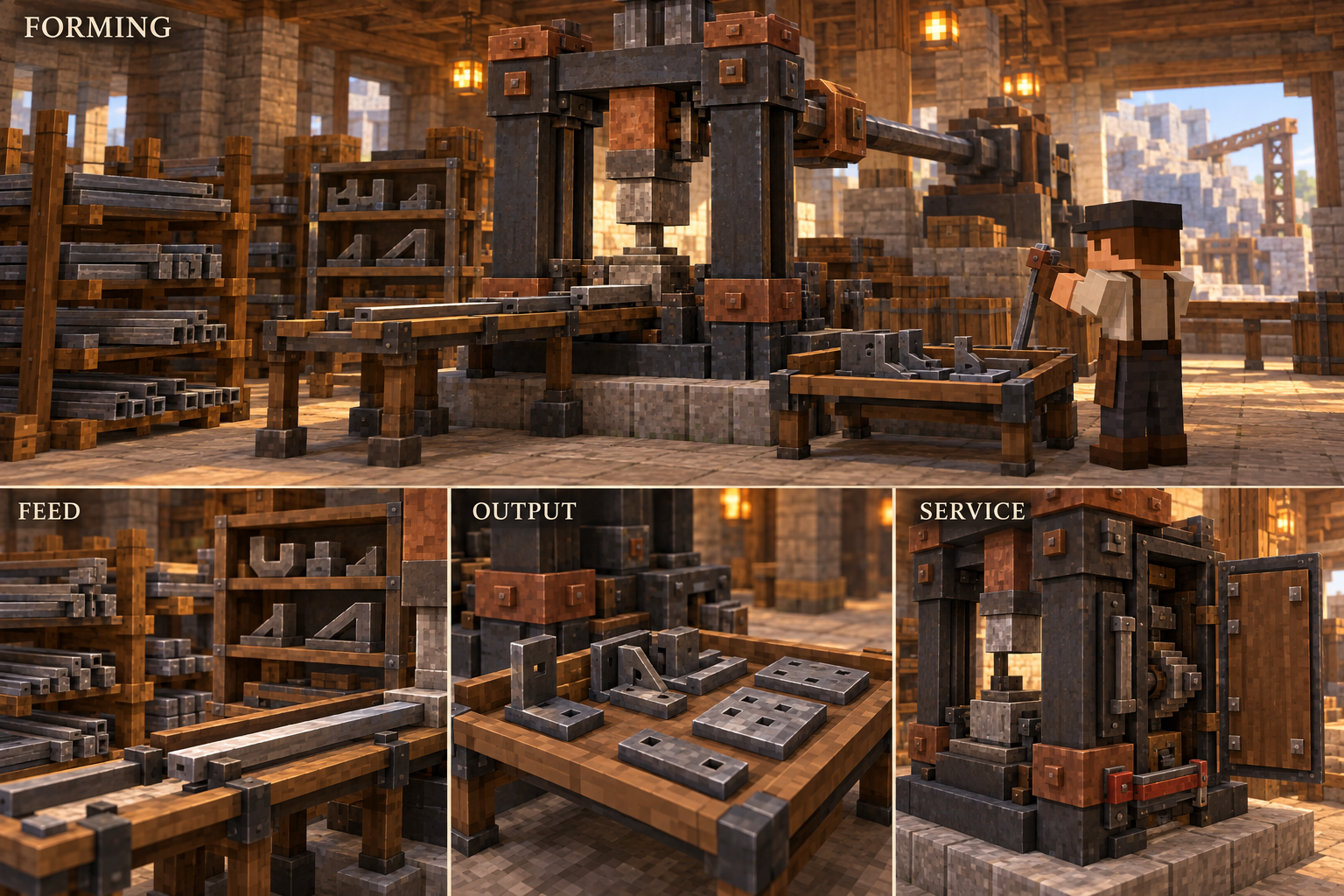
Concept artwork · CD05-A03IND-M04 · A regional forming press increases capacity. Simpler shaping stays available earlier; this press is optional for the first lunar journey.
Concept artwork · CD05-A03The feed side shows which physical stock is ready for work.
Concept artwork · CD05-A03Completed work has a real destination. A full output stops further work without inventing or losing items.
Concept artwork · CD05-A03Service access stays clear. The machine pauses when an ordinary input or service is missing.
The intended states distinguish work, waiting and service. Ordinary shortages pause work and preserve real stock.
IdleNo order is running.
ReadyThe next work can begin.
ActiveThe machine is doing its job.
Output blockedMake room for the result.
PausedWork waits with its state retained.
Service requiredA visible need must be addressed.
The forming press shown above is an optional capacity improvement. Simple shaping remains available earlier; the first lunar journey must not depend on installing this particular machine.
03 / A complete expedition
Earth. Moon. Home.
The journey begins in a workshop you already know and ends with one useful improvement there. Every essential for the first trip comes from Earth.
An existing workshop, known Earth gathering routes and useful electricity supply the journey. Common structural stock, glass, ceramics, fibers, seals and circuits all need reachable first sources.
What you haveReuse the workshop. Prepare the four capabilities below.
Workshop electricity supports each preparation. All four capabilities meet at commissioning; none can be replaced by a promise to manufacture it after landing.
01
One reusable Explorer
Use the Part Fabrication Table to make recognized components, then the Rocket Assembly Station to assemble and commission one Explorer for orbital and lunar journeys. Four visible nozzles belong to one engine cluster; the station serves a separate assembly berth.
Prepare the complete suit, reusable breathing vessels, route tools and a complete Earth-made starter refuge. Its hardware, stock and packed contents all have to fit.
Use the Fuel Refinery to produce actual fuel on Earth and transfer it into compatible storage. Set aside the real return and emergency allocation before optional work.
Use the Oxygen Generator’s proposed Earth process to fill the cabin, suit vessels and refuge. Distinguish the reusable vessel from the supply inside it.
Build onceInstalled workshop and launch infrastructure remain available for later journeys.
Use againThe Explorer, suit, vessels and tools retain their own identity. Refill and service them.
Consume deliberatelyFuel, breathing supply, charge and declared service stock come from real stores.
A second mission does not buy the workshop and spacecraft again. Proposed numerical supply examples remain in the reference; they are not approved capacities or durations.
02
Make the whole round trip ready
Check the actual craft, pilot, complete refuge, supplies, route kit and room for samples together. Protect fuel, breathing supply and electrical reserves separately. An allocation marks real stock; it does not create more.
What you haveA complete departure, refuge, expedition and return plan.
Propellant, breathing supply and electrical charge are separate accounts in compatible stores. Reserve labels assign a purpose to stock that actually exists. Ordinary work must not withdraw protected return, contingency or occupied-refuge allocations.
Pack and check both manifests: the outbound craft needs room for every essential; the return needs room for the chosen samples and retained equipment. Craft interior, cabin and cargo fit remain unresolved design work.
Candidate Earth processes for propellant and breathing supply are still proposed recipes. Their raw materials, power, service, yield and byproducts must all be resolved before a complete cost can be claimed.
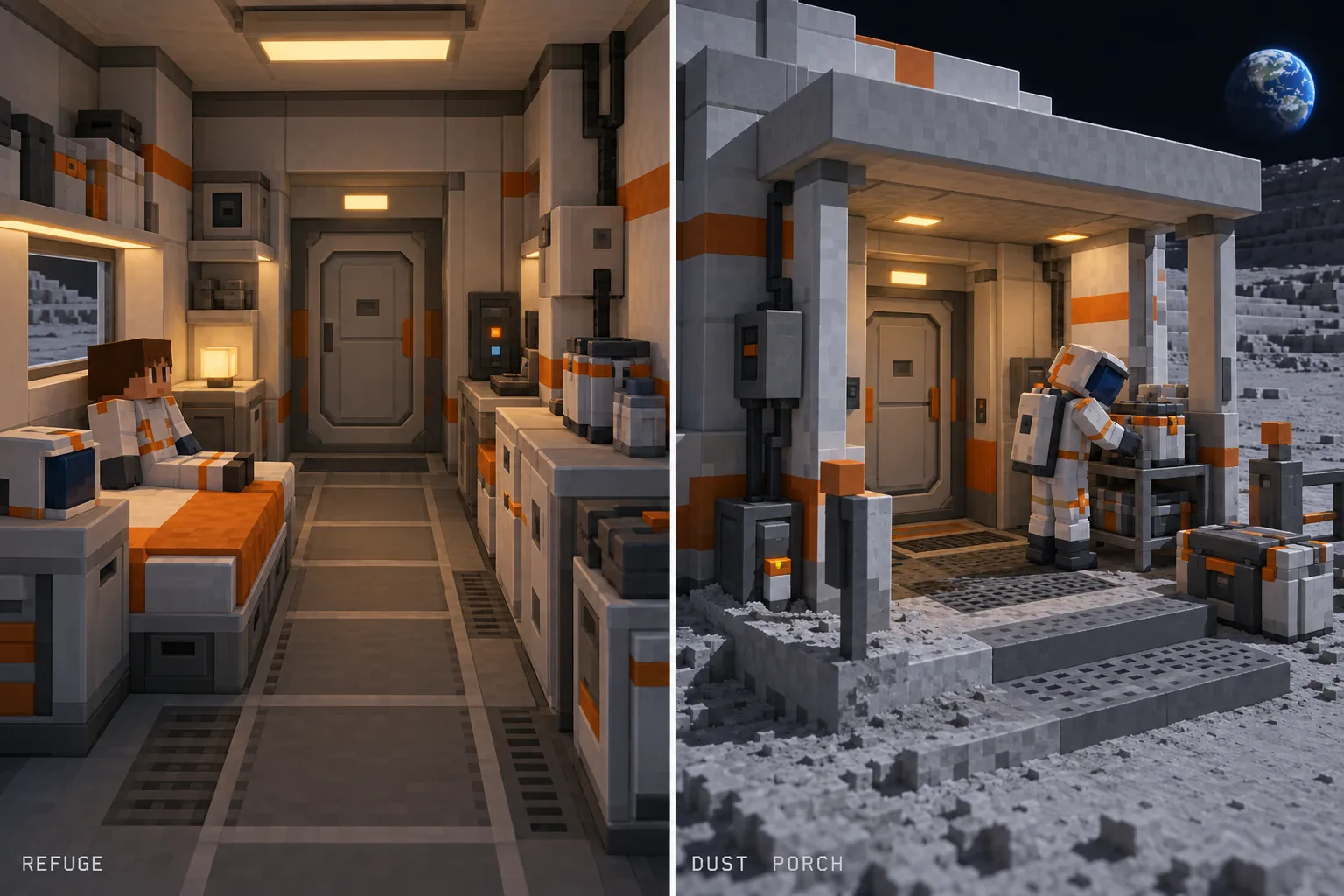
Make a short surface inspection with the Explorer as the first retreat. Then commission the independent refuge before descending: a supported room, working services and an airlock with two closures.
What you haveA dependable place to rest, sort tools and check the next walk.
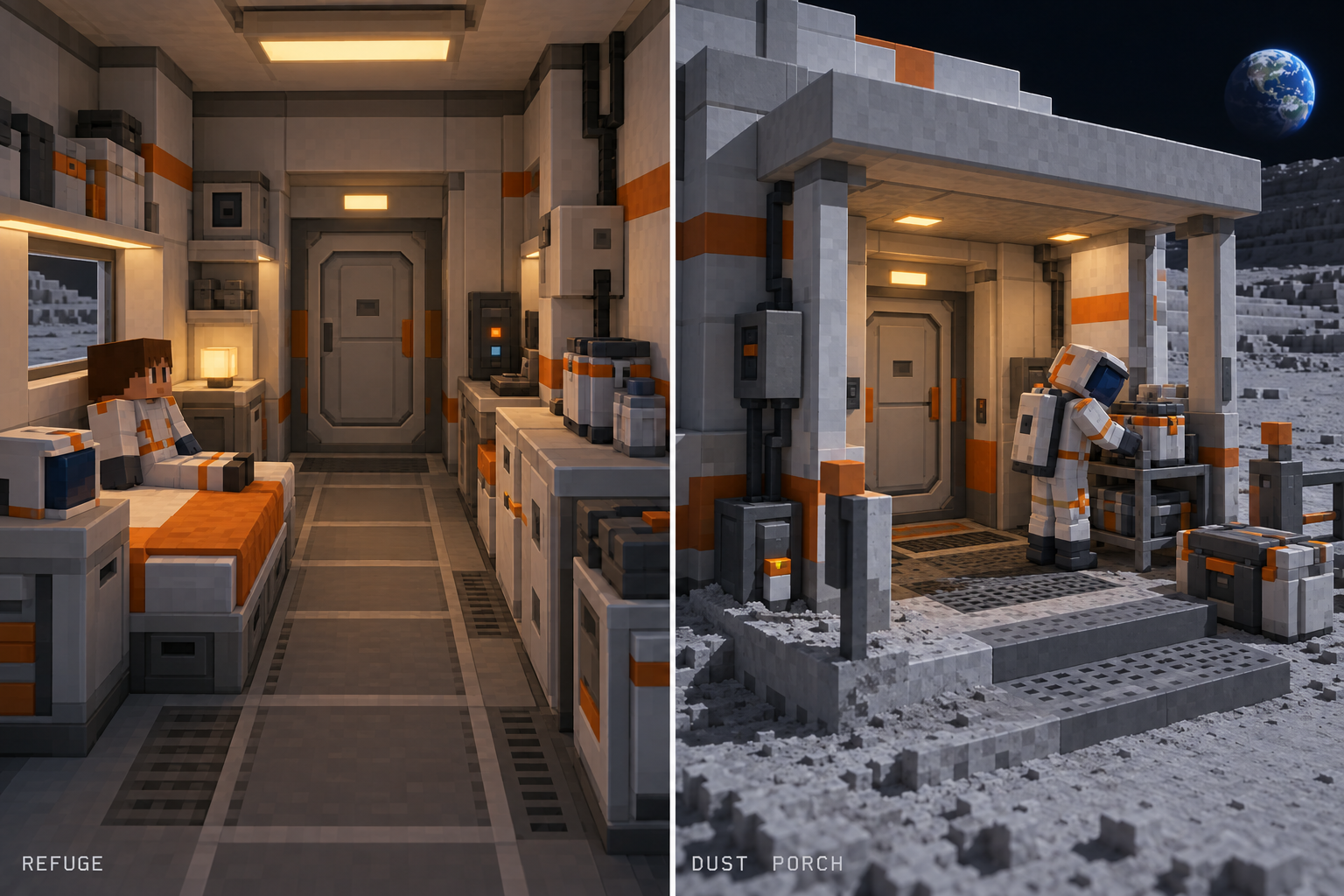
Concept artwork · CD05-A02The initial refuge needs a protected cell, real supply and power services, and an airlock with inner and outer closures. The image is a concept, not approved dimensions or proof of fit.
Concept artwork · CD05-A02The pictured dust porch and expanded stores are optional later additions. They are not a hidden requirement for the first supported room.
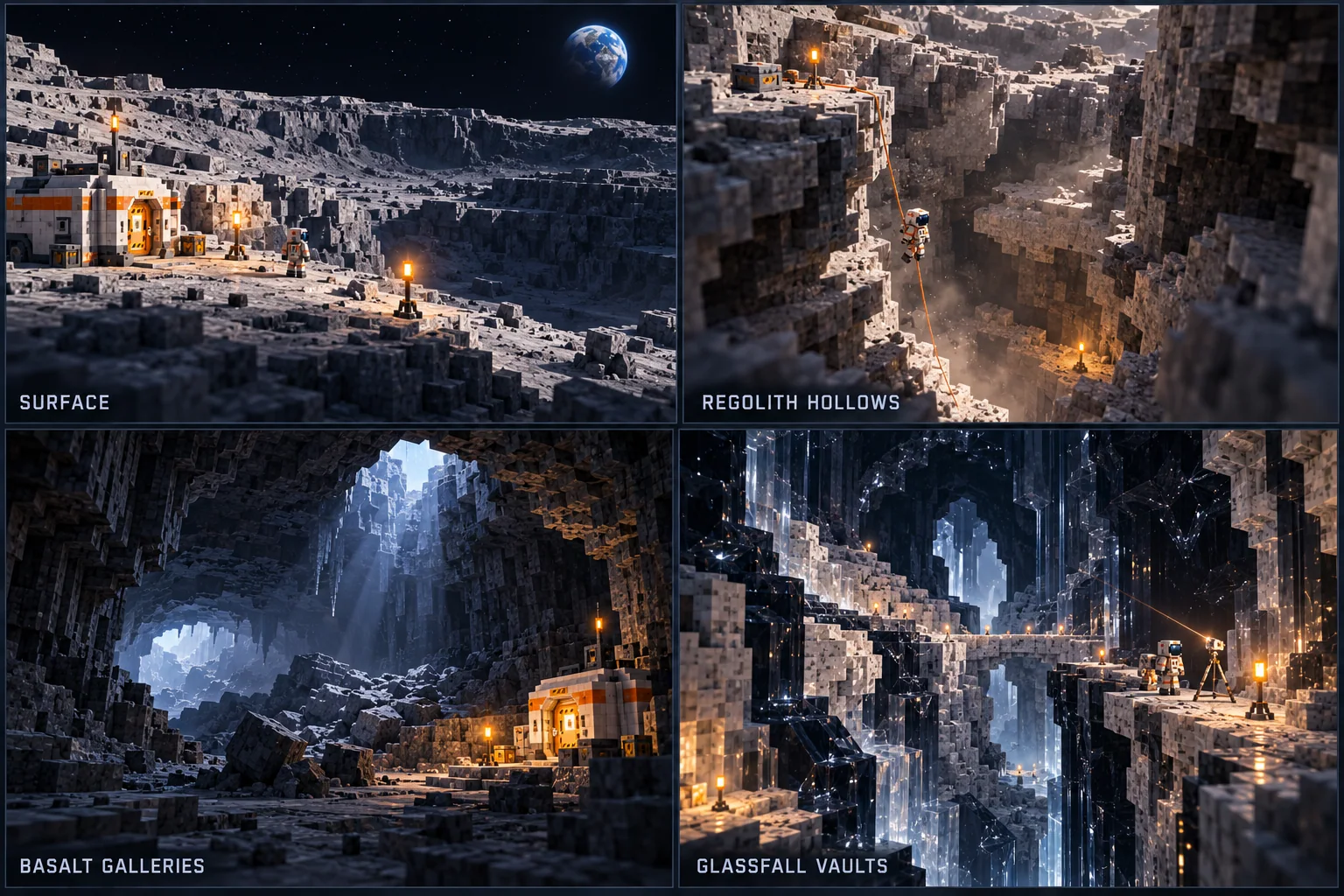
Follow a marked route through Regolith Hollows to an accessible Basalt Galleries overlook. Take a modest regolith and glass-bearing collection, record the place and see Earth through the broken roof. A short dark branch is optional.
What you haveA satisfying first expedition without a factory, the full basin route or the Glassfall Vaults.
OV-MOON · Basalt Galleries scene extract. The first mission uses an accessible overlook; this illustration is not a finalized route or refuge layout.
A marked route. A small collection. A view of the world you came from.
05
Bring the discovery home
Return in the same Explorer with actual samples and recorded observations. Set aside a preserved specimen, reserve some real feedstock for processing and keep an unprocessed reserve. A record of a sample is not another sample.
What you haveA collection you can study without spending every specimen.
Choose a Regolith Ceramic thermal or habitat component, or a Lunar Glass Filament light guide or survey component. Fit it to a familiar place or tool, such as a quarry work light. The first collection must be sufficient for one useful application once recipes are settled.
What you haveAn improvement at home, with the craft and workshop ready to serve another journey.
Use a supported habitat or thermal component to improve a familiar sheltered place.
orPM02 / Lunar Glass Filament
A better way to see
Fit a light guide or survey component to an instrument or quarry work light.
Choose one first application. Exact sample yields and recipes remain open; the final balance must let a modest first collection produce something useful while preserved specimens remain unspent.
When a plan has to change +
A full output or missing power pauses workshop work without duplicating or losing stock. An obstructed or incomplete refuge sends you back to the Explorer while you correct placement or missing services.
Low field supplies mean retreat, service or a declared contingency. A disabled craft uses a configured recovery association with visible consequences for cargo and salvage; it is not a free duplicate craft or inventory.
Managed regional pause applies to supported authored systems when the last eligible participant leaves. A teammate who remains keeps the region active. Your suit continues to consume its operating supply while you explore.
These supplied diagrams show dependencies, supported spaces and route choices. They describe proposed relationships; their presence does not settle recipes, scale or capacity.
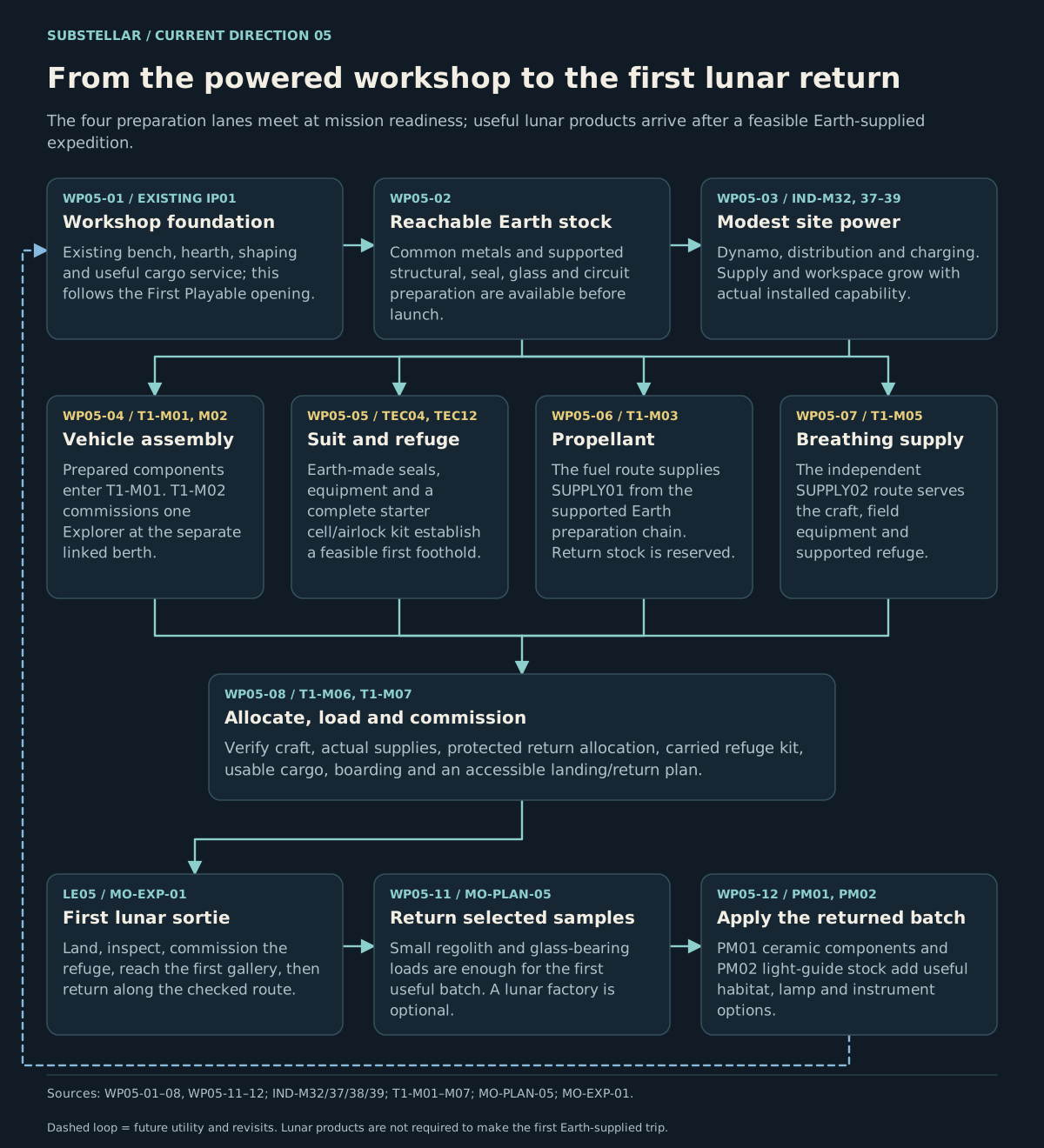
From the powered workshop to the first lunar return+
Four independently prepared capabilities meet at commissioning. Returned lunar material expands useful options after the first complete expedition.
CD05-D02 · Source diagram. Functional dependencies only; numerical recipes, pacing and production scale remain proposed. An installed regional forming press improves capacity; simple shaping remains available earlier.
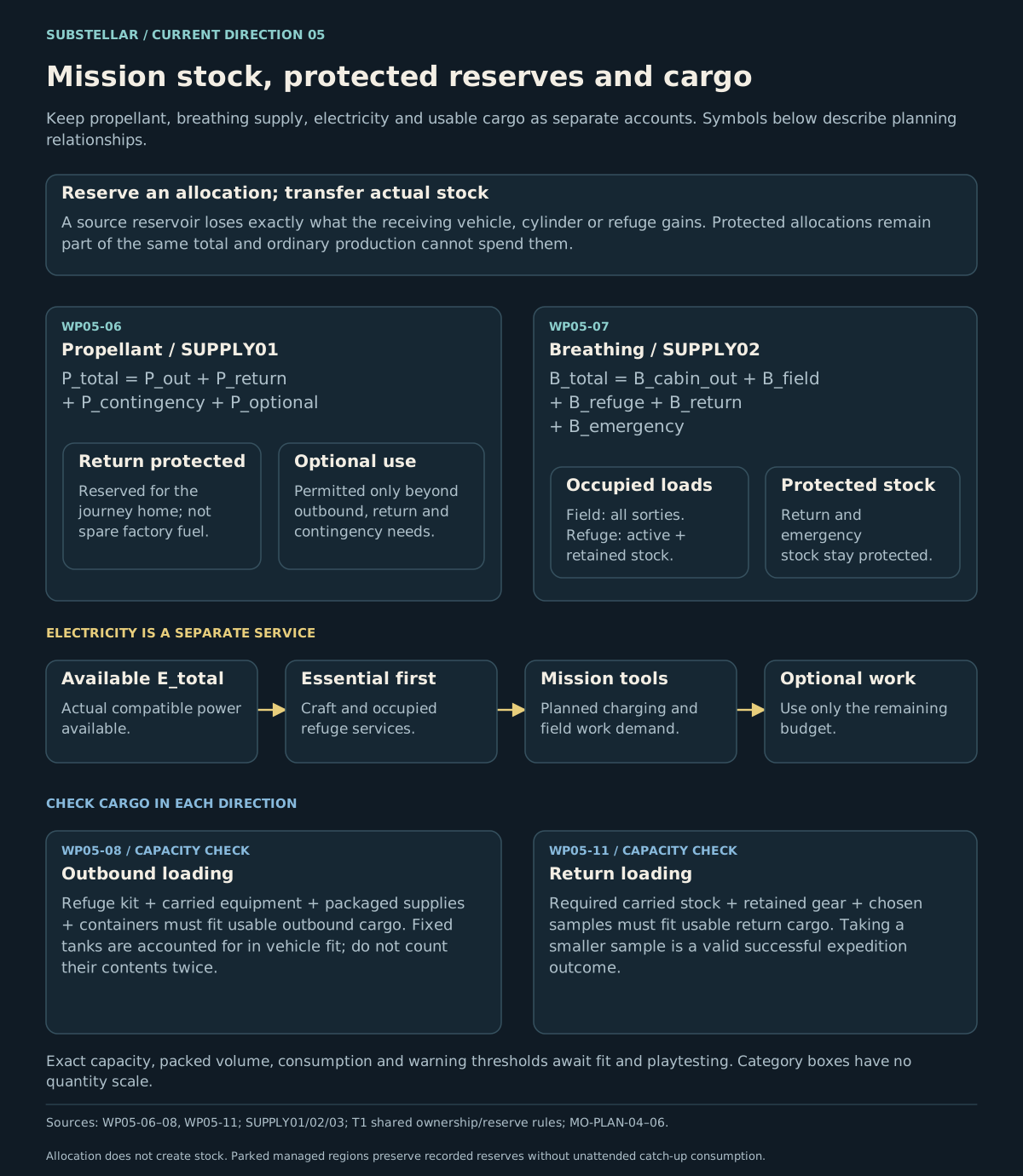
Independent symbolic accounts protect the return journey while keeping physical transfers and both cargo manifests coherent.
CD05-D03 · Source diagram. Symbols are explanatory variables, not new inventory items, units, recipes or finalized capacity values. Actual craft/refuge volumes and thresholds remain subject to measured fit and playtesting.
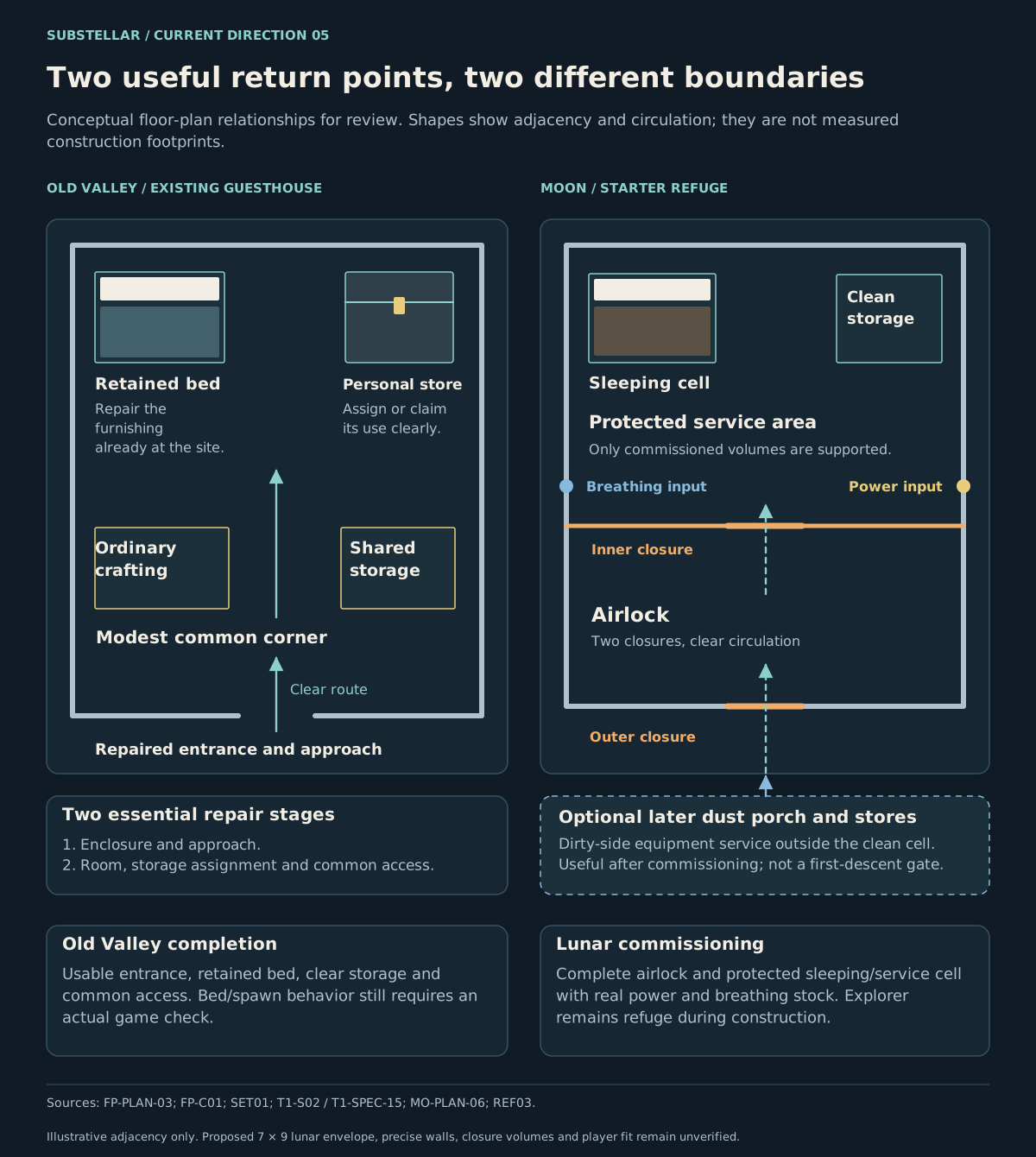
The guesthouse repairs an existing room; the lunar refuge commissions a defined supported cell and airlock. Both provide a clear return route, storage and an occupied place to rest.
CD05-D04 · Source diagram. Plan shapes are conceptual and have no construction scale. The optional dust porch/stores are a later convenience stage, not a requirement before the first descent. The proposed lunar 7 × 9 footprint and all measured access remain pending fit.
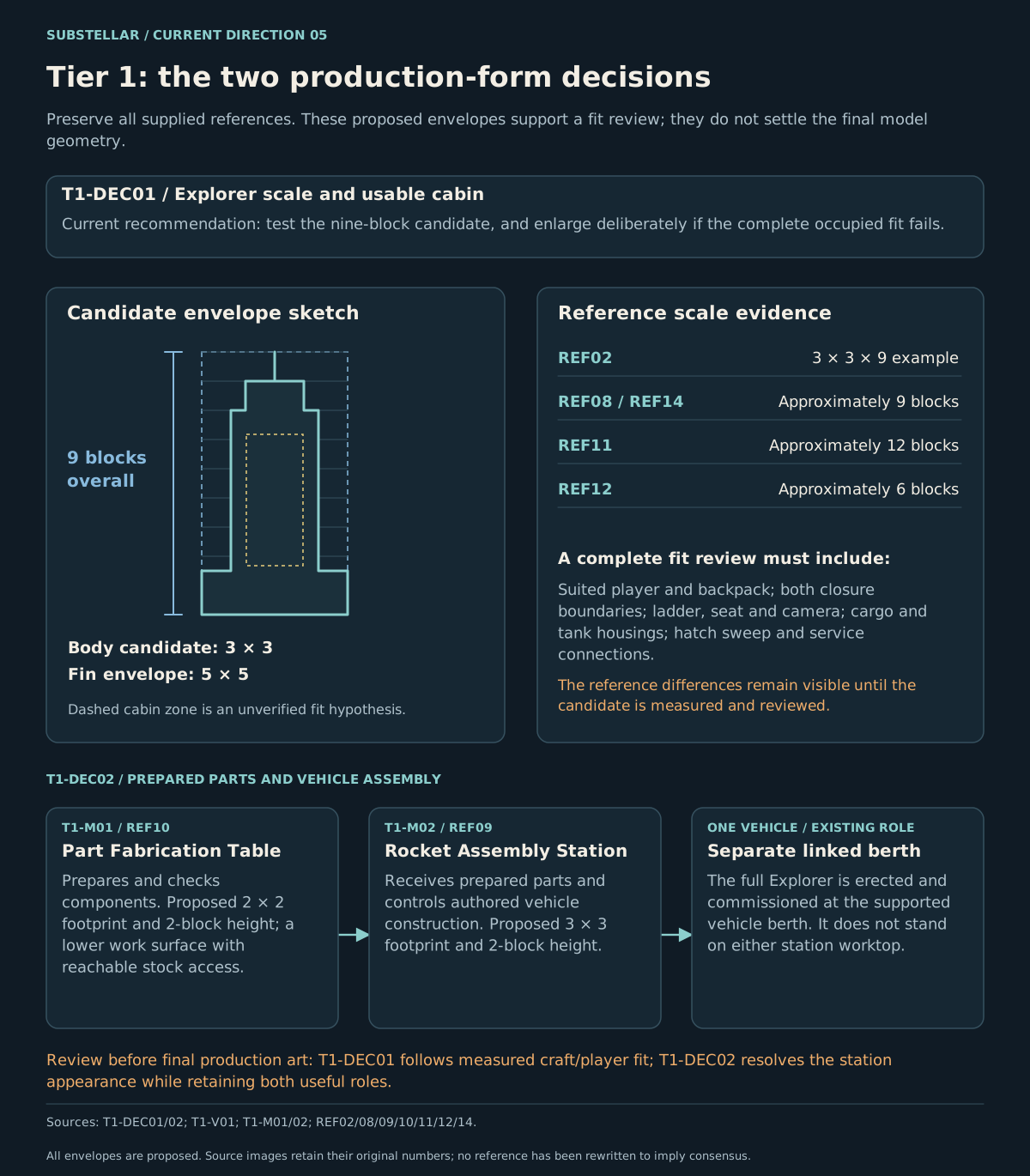
Review the Explorer candidate against preserved scale evidence, then compare the two stations by their distinct jobs and proposed working envelopes.
CD05-D05 · Source diagram. Nine-block rocket height, 3 × 3 body, 5 × 5 fins and station sizes are current proposed defaults. The schematic cabin zone is not a validated usable cabin. T1-DEC01 and T1-DEC02 remain pending final model review.
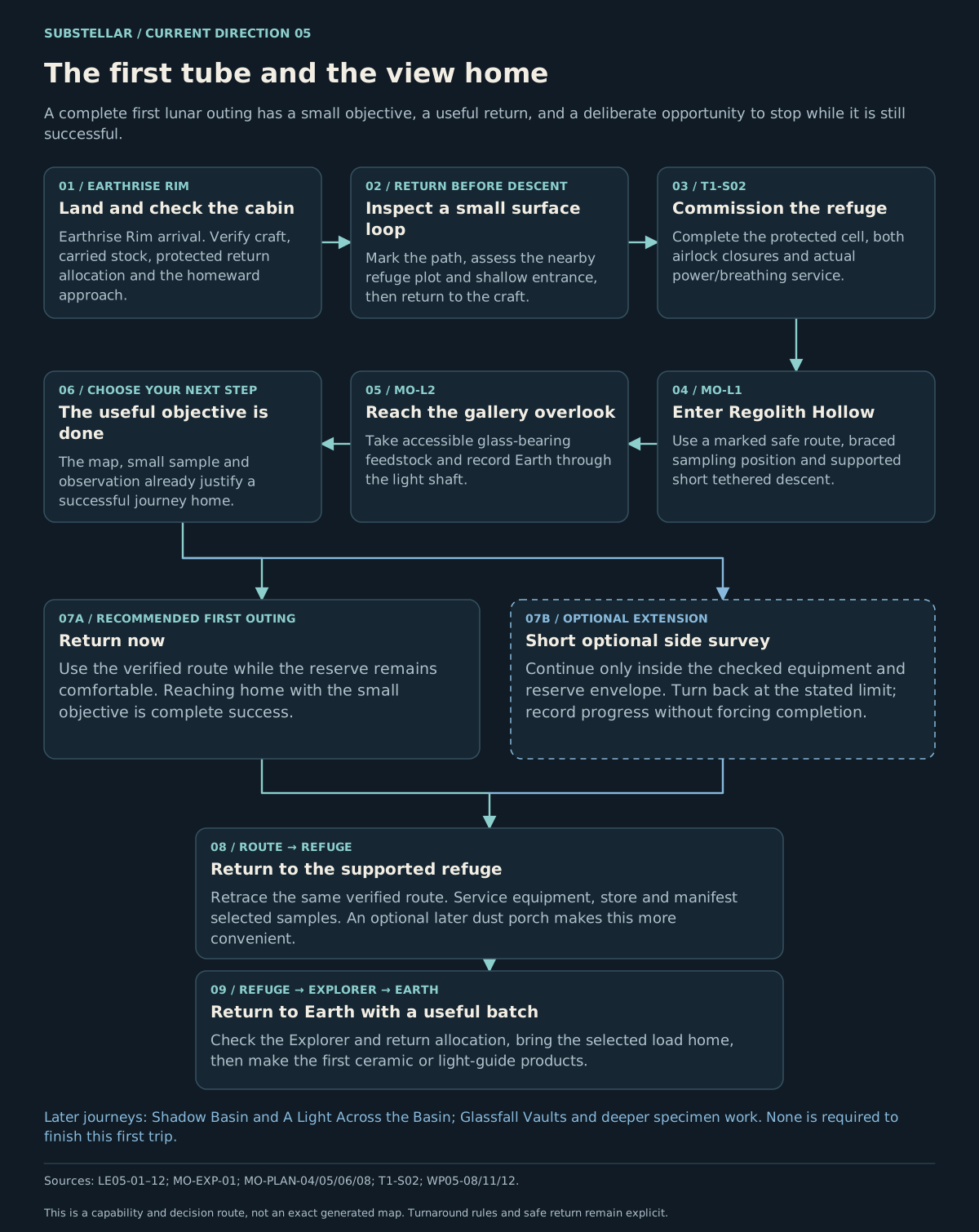
The first lunar objective is complete at the accessible Basalt Gallery. Returning then is a full success; a short optional survey remains bounded by the checked equipment, route and reserves.
CD05-D06 · Source diagram. The route is an authored relationship diagram and does not establish measured terrain or exact map placement. The commissioned airlock/sleeping cell precedes committed descent. Dust porch/stores are optional later conveniences. Shadow Basin and Glassfall remain subsequent journeys.